Press and hold the image, then choose Save to Photos.
In orderNo. 24 of 24
Soundd
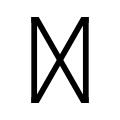
The nameday
Old English runedæg
✦
In the Old English Rune Poem
D. (day), the glorious light of the Creator, is sent by the Lord; it is beloved of men, a source of hope and happiness to rich and poor, and of service to all.
Where this comes from
The Old English Rune Poem is the fullest surviving poem about the runes. It describes the Anglo-Saxon futhorc, which grew out of the Elder Futhark, so the stanza below belongs to the Old English rune that continues this one rather than to the Elder Futhark rune itself.
The Anglo-Saxon Runic Poem, translated by Bruce Dickins in Runic and Heroic Poems of the Old Teutonic Peoples (Cambridge University Press, 1915). The text and the runes are in the public domain.
The letterform is redrawn from the public-domain vector runes on Wikimedia Commons, set on a common canvas so every rune in the row is the same size.